
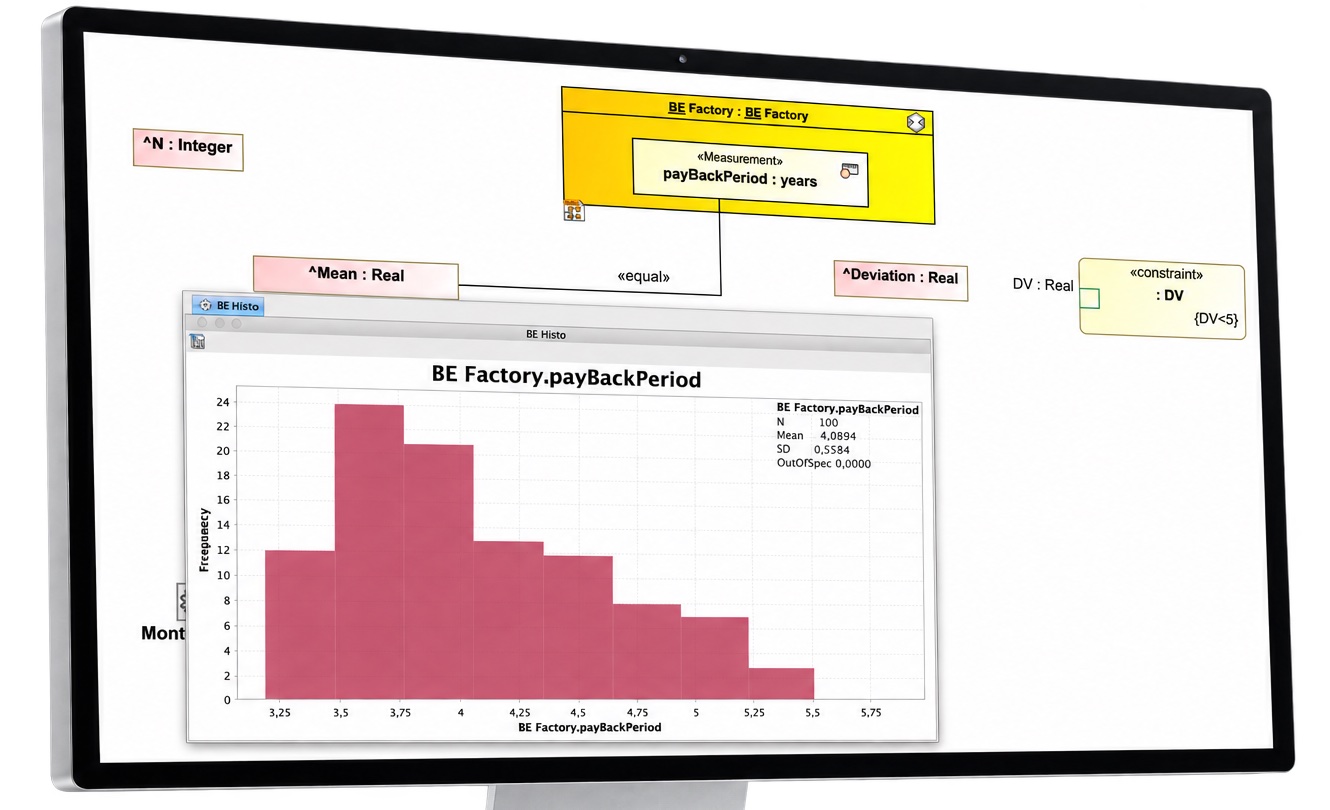
Simulations run directly on the proposed architecture model. They make it possible to assess the effect of its changes on the results.
MANGO Green Power
MANGO Green Power is a virtual biofuels company. With this demonstrator, PYLIA shows how to apply systems engineering to the enterprise: design it virtually, explore how it works and compare organisational and investment choices before implementing them.
Applying an industrial approach to the enterprise
In industry, the digital twin makes it possible to design a product, study its behaviour and plan its manufacture and maintenance. Simulation helps compare solutions and optimise choices before they are implemented. Data from operations then enriches the model, in a continuous improvement cycle.
With MANGO Green Power, PYLIA illustrates how this logic can be transposed to the enterprise itself.
In the virtual world
Design, explore and decide
The model links MANGO Green Power’s strategic ambition to its operations and resources: teams, skills, processes, facilities, information and partners.
Analysis and simulation make it possible to compare several organisations and anticipate their performance, before committing the resources to build them.
From model to implementation
Build, learn and transform
The model becomes a reference for putting the chosen organisation in place and taking action. In an operating enterprise, results and lessons learned then enrich the model and inform future changes.
The digital twin thus supports the enterprise throughout its life, from its initial design through to steering its transformations.
An approach that applies at several scales
The scope can be an entire company, but also a department, a business activity or the organisation set up to run a transformation project. What matters is to represent a coherent whole, its objectives, its resources and its interactions.